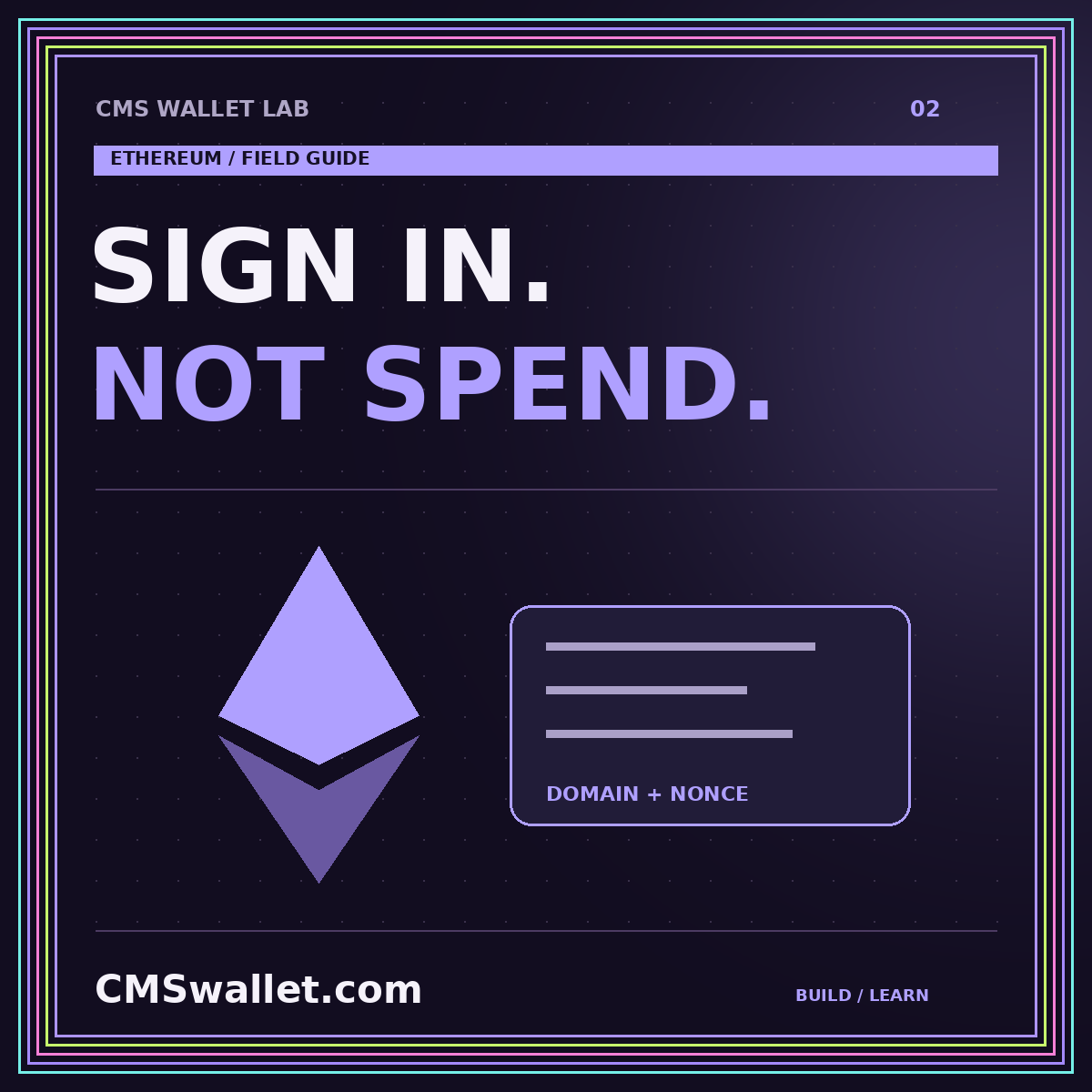
An Ethereum CMS wallet sign-in should answer a narrow question: can this visitor demonstrate control of the account named in the request? It should not silently become a payment, a token approval, or permission to edit the website. Designing that distinction clearly is the first step toward a useful reader experience.
This guide proposes a sign-in workflow for a publication that wants wallet-based membership access. It focuses on the decisions around verification, session lifetime, account changes, and support. The public publication can remain static, but issuing and enforcing a trusted login session requires an appropriate verification service beyond a collection of public HTML files.
Establish the scope before asking for a signature
Write the sign-in purpose in plain language. A reader should understand which website is requesting the signature and what successful verification will unlock. Avoid vague prompts such as “Verify everything” or “Continue securely.” For the example publication, a better intention is to sign in to the members library without authorizing a blockchain transaction.
Keep wallet selection separate from signature consent. Showing an address after connection is a useful interface state, but it should not open protected content. Let the reader inspect the next action before it starts. This separation also makes cancellation easy to explain: selecting a wallet and declining sign-in should leave the website in a predictable, signed-out state.
Use the sign-in standard as the reference
The Sign-In with Ethereum specification, ERC-4361, defines a structured message with fields including the requesting domain, address, URI, version, chain ID, nonce, and issue time. It also specifies verification of message contents and signatures. Sessions are bound to the address, and contract-account verification requires attention to the chain identified in the message.
Treat those requirements as a protocol boundary, not a reason to hand-write a parser during a rushed launch. Select a maintained implementation, review its supported account types, and test the exact library version you deploy. The rest of this guide describes a proposed application design around that standard rather than replacing the standard with an informal checklist.
Make the challenge belong to an attempt
In the proposed flow, the verification service creates a short-lived challenge associated with the current sign-in attempt. Store the expected origin, intended account context, and expiration alongside it. Do not accept arbitrary client-provided values simply because a valid signature accompanies them. The verifier needs to compare the signed message with what the service intended to request.
Plan how concurrent attempts behave. A reader may open two tabs or retry after a slow response. Decide whether a new attempt invalidates the previous one, and make that policy visible in tests. Once a challenge succeeds, prevent another use of the same attempt from creating a second independent session. An atomic state transition is preferable to separate checks that can race.
Preserve the message being verified
Pass the exact signed message to verification rather than reconstructing it from a display name and a few fields. Differences in whitespace or encoding should produce a clear verification failure, not a guess about the user's intent. Record a correlation identifier for support, but avoid putting complete reusable authentication material into routine browser logs or analytics events.
Treat account types as an explicit compatibility decision
Do not make “Ethereum account” a synonym for one browser extension or one signature-recovery technique. Ask the chosen implementation what it supports, including relevant contract-account behavior. For every advertised account type, maintain a successful test and at least one invalid-signature test. A product page should describe tested coverage rather than suggesting universal compatibility.
For an unsupported account, return a useful explanation before the reader repeats the same unsuccessful action. Avoid asking them to move assets or reveal private information to make the login work. Where the product offers another authentication method, explain that route independently. The Ethereum CMS wallet topic page provides the broader integration context for these decisions.
Build a session policy, not just a verification endpoint
After verification, decide what the resulting session can do and how long it remains valid. A reader session should not automatically inherit editorial or administrative powers. Link it to the smallest account record needed for the publication's task. Define whether sensitive actions require a fresh verification step instead of relying on an old login indefinitely.
Think through logout across the browser and the service. Removing an address from the interface is not a complete logout policy when a trusted session still exists elsewhere. Likewise, disconnecting a wallet connector may not clear an application session. Provide a visible sign-out action in the actual application and test its effect on protected resource requests, not only on the navigation label.
Reconcile account changes deliberately
Imagine a reader signs in with one wallet account and later selects another. Do not silently rewrite the session's identity to match the newly selected address. In the proposed design, pause account-dependent actions and require a new sign-in before treating the second address as authenticated. Keep already-rendered public content available while explaining why the protected action needs attention.
Account linking deserves its own workflow. Require proof for the new address and an authorized existing session, then record the relationship through a reviewed account-management operation. Do not merge profiles because two wallets expose similar names. A misleading merge can become an access-control problem that is harder to fix than an ordinary sign-in error.
Keep authorization separate from authentication
Successful sign-in establishes an identity context; it does not establish that the reader owns a particular token, purchased a particular issue, or has permission to modify content. Evaluate those requirements through separate policies. Give the resulting access decision a resource identifier and a freshness rule so its scope is understandable.
For example, membership for a workshop recording should not automatically grant access to every private file in the same storage location. Recheck authorization at the delivery boundary. The token-gated content guide explains why a visually hidden download link is not a substitute for protected delivery, even when the wallet sign-in itself is correctly implemented.
Write failure copy that matches the evidence
Distinguish a user declining to sign from a service failing to verify. “You canceled sign-in” respects the user's decision; “Security failure” suggests a problem the system has not established. For an expired challenge, explain that a new request is needed. For an unavailable verification service, preserve the requested destination and offer a deliberate retry rather than looping prompts.
Avoid promising that a signature is harmless in every context. Describe the specific sign-in request presented by this application, and keep payment or approval workflows visibly separate. Review the wording with a person who did not build the system. They should be able to say what the request does, who requested it, and how to stop without guessing from technical labels.
Create a release test matrix
Test a valid request, wrong domain, expired attempt, mismatched account, altered message, reused challenge, unsupported account type, and two simultaneous submissions. Also test service timeouts before and after verification succeeds. A retry must not create conflicting sessions or leave the reader unsure whether the original attempt completed.
Run the same journey on mobile, including the transition into a wallet app and back. Verify that the original article remains the destination after sign-in. Record the wallet, browser, operating environment, and application build used in each test. This produces a concrete compatibility record rather than a general claim that the interface works everywhere.
Conclusion: a signature is one step in a larger system
An Ethereum CMS wallet sign-in needs a clear purpose, a standards-based message, a trusted verification boundary, and an explicit session policy. Its value comes from those pieces working together, not from replacing the word “password” with a wallet icon.
Begin with the CMS wallet architecture guide and keep the implementation narrow enough to test thoroughly. When every transition has a defined meaning, readers can understand what they are authorizing and the publication can distinguish identity, membership, and payment without conflating them.