A wallet integration becomes harder to maintain when access rules are scattered across article templates, front-end conditionals, and informal editor notes. A headless CMS offers an opportunity to separate those concerns, but only if the content model makes the separation explicit. Adding a field called “web3 enabled” does not explain what a resource requires or who may change that requirement.
This guide proposes a content model for a publication with public articles, protected workshops, and wallet-based reader identity in a separate application. It focuses on the relationship between editorial content and reviewed access policies. The model is intentionally descriptive: the CMS can refer to a policy without becoming the component that executes wallet verification or authorizes protected delivery.
Start with the public article model
Define the fields that belong to editorial publishing: title, slug, summary, body, category, tags, featured image, publication date, and revision information where it genuinely exists. Keep their purpose readable to editors. A title field should not double as a policy selector, and a tag should not quietly determine administrative privileges.
Add an explicit visibility classification for content that has both public and protected representations. For the proposed workshop, the public record contains a summary and illustration, while the protected resource record identifies the full recording and transcript. Make this distinction visible in the editing interface so an editor can see whether a field is intended for public export before entering sensitive material.
Model the protected resource independently
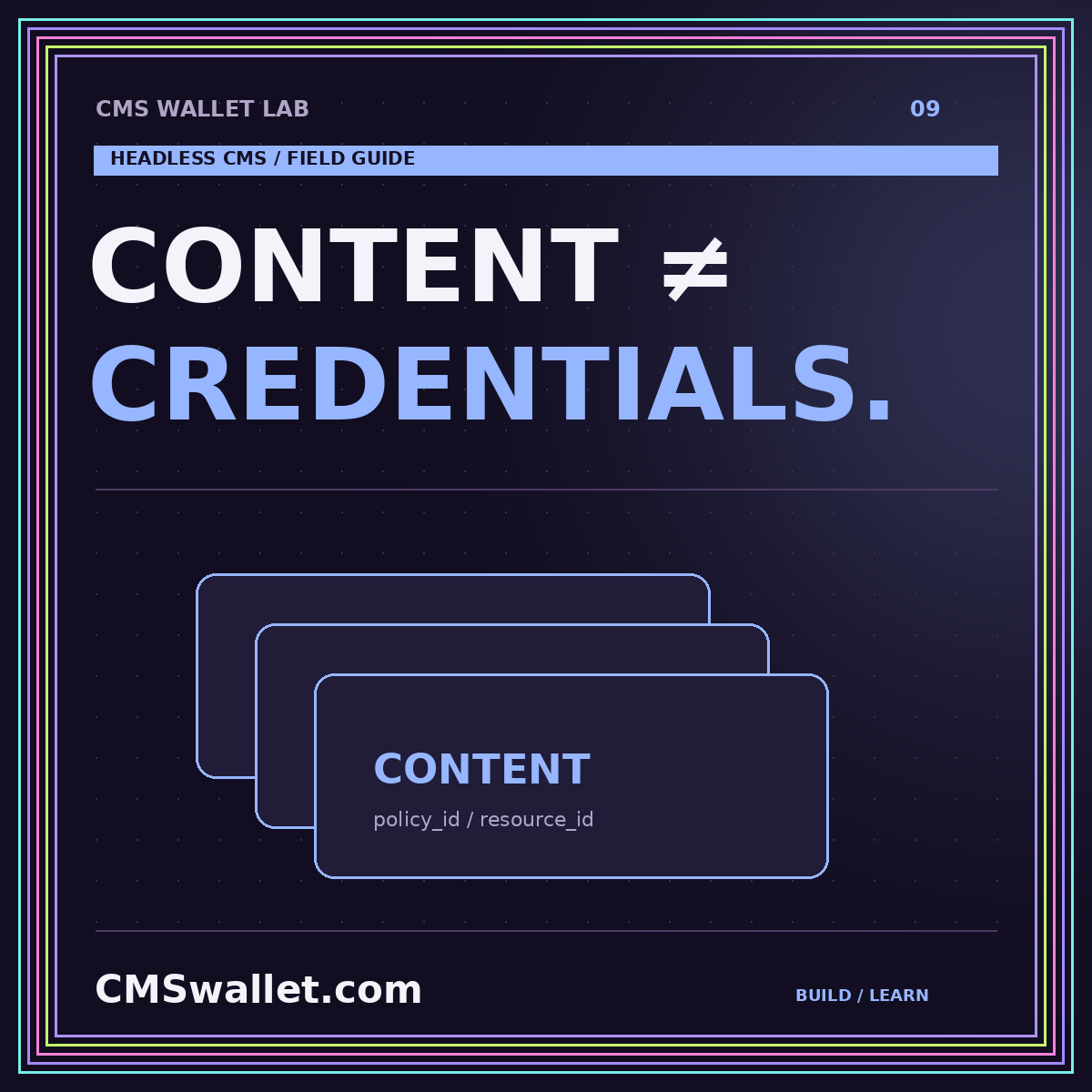
Give each protected resource a stable identifier that does not depend on its current title or URL. Record its type, delivery location reference, lifecycle state, and associated access-policy identifier. Store actual storage credentials outside the content model. A CMS record can describe where a resource belongs without exposing the means to retrieve every private asset.
Separating resource identity from page identity helps when the same recording appears in several editorial contexts. A category page, an article, and a workshop landing page can all refer to the same protected resource. The authorization rule should remain attached to that resource rather than being copied into each presentation, where later edits could leave inconsistent versions.
Use reviewed policy references
Create a registry of access policies owned by the appropriate operational team. An editor may choose a policy such as workshop-member-v1 from an approved set. The policy record should explain its intended use in reader-friendly language, but the actual enforcement logic belongs at a trusted boundary. Do not let free-form article text become executable authorization code.
Define who can create, revise, retire, and assign policies. These are different powers. A managing editor might assign an existing policy while a separately authorized administrator reviews changes to its accepted network or asset. The Content Management System wallet overview explains the broader division between publishing models, identity services, and resource delivery.
Keep CMS credentials separate from reader identity
A reader proving control of a wallet should not automatically gain the credentials used by the CMS integration. Treat the publication's service identity and the reader's identity as distinct subjects with different permissions. The reader may be authorized to retrieve one workshop; the publishing service may be authorized to export public article metadata. Neither permission implies the other.
As a concrete platform example, the WordPress REST API authentication documentation distinguishes authentication mechanisms and notes that the current user still needs the appropriate capability for an action. A wallet signature is not a substitute for whatever authentication and capability checks a CMS API requires. Review the actual platform boundary rather than assuming that “headless” removes it.
Design the public export deliberately
Write an allowlist of fields that may enter the public static build. Include public article bodies, summaries, images, taxonomy descriptions, and canonical metadata as intended. Exclude private transcripts, storage secrets, reader records, and internal policy notes. Review the resulting HTML and generated data files, not only the export configuration.
Keep RSS and social previews in the same review. A private paragraph can leak through a full-content feed even when the normal article page is gated. An automatically generated image might reproduce restricted text. The web3 token-gating guide provides an asset-inventory approach that helps cover these less obvious publication routes.
Use a public projection rather than hidden fields
For the proposed system, create a clearly defined public representation of each content record. The build consumes that representation instead of a complete administrative response with selected fields hidden afterward. This reduces the number of places where an accidental serialization choice can expose material that was never intended for public delivery.
Version rules without inventing article updates
Distinguish an editorial revision from an operational policy change. Correcting an article's wording may justify a genuine content modification date. Revising an access rule may require its own policy version and effective date. Neither event should automatically make every article appear newly updated. Keep the metadata connected to the event it actually describes.
When a policy changes, decide whether existing entitlements remain valid and how the delivery service recognizes the transition. Preserve enough history to explain which rule applied to an earlier order or access decision. A version identifier is useful only when the corresponding meaning can be recovered, so avoid reusing the same identifier for materially different behavior.
Make previews and drafts explicit
Editors need previews, but preview access should be reviewed as a separate capability. Do not assume that an obscure preview URL is private simply because it is absent from navigation. Determine who can obtain it, how long it remains usable, and which content it can reveal. Keep draft preview handling outside the public static export.
Test scheduled publishing and unpublishing. A draft may be absent from the main page but remain in a cached feed or generated archive. Define how withdrawing a protected resource affects public references, existing entitlements, and delivery. The intended behavior may differ for an editorial correction, a rights issue, or a permanently retired workshop; document those cases rather than treating all removal as deletion.
Separate taxonomy from authorization
Categories and tags help readers navigate topics. They should remain understandable editorial tools rather than secret permission switches. An article tagged Ethereum might discuss architecture without requiring an Ethereum wallet to read it. A category archive should not inherit private resource access merely because one associated article mentions a membership feature.
Give archives useful descriptions and connect them to the right topic hubs. This improves discoverability without duplicating every article's introduction. Keep public taxonomy metadata safe for export even when some related resources are restricted. The publication can explain that a workshop exists while still protecting the full recording through the appropriate delivery service.
Define the contract between publishing and operations
Write down the events each team needs. Publishing may announce that a resource is ready for release; operations may confirm that its delivery policy is available. Avoid coupling those events through an undocumented naming convention. A typo in a slug should not accidentally select a different policy or expose a private storage path.
Use validation to catch missing resource identifiers, retired policy references, absent image dimensions, and incomplete public descriptions before release. Keep the failure message actionable for editors. “Select an active access policy for this workshop” is more helpful than a generic build error. The validation rules should reflect the content contract, not incidental details of one front-end template.
Test a complete resource lifecycle
Walk through creating a draft, previewing it, assigning a policy, publishing a public summary, authorizing delivery, changing the title, revising the policy, and retiring the resource. Verify that identifiers remain stable where intended and that public URLs continue to resolve or are handled deliberately. Check that no private material appears in feeds or generated assets during any transition.
Use separate roles for the editor, policy administrator, reader, and support reviewer. A lifecycle test often reveals permission problems that isolated endpoint tests miss. The CMS wallet security checklist expands these scenarios into a broader release review.
Conclusion: model the relationship, not the secret
A useful headless CMS wallet model stores editorial content, public projections, resource identifiers, and reviewed policy references. It keeps operational credentials and authorization enforcement in the systems responsible for them.
Start with a small set of explicit content types and a documented lifecycle. That structure lets editors publish confidently while developers can change wallet providers or delivery services without turning every article template into a second security policy engine.