The visible cost of a CMS wallet integration is often a plugin license or a hosted service plan. The complete cost includes far more: implementation, network interaction, infrastructure, testing, support, and the work required when an order or sign-in fails. A useful estimate makes those categories explicit instead of reducing the project to a single transaction-fee comparison.
This guide develops a planning method for a publication considering Ethereum, Solana, and Bitcoin-related workflows. It does not quote current provider prices or predict cryptocurrency fees. The examples are design scenarios, and any real budget should use measured usage and the actual terms of the services selected for the project.
Define the unit you are estimating
Start with a completed reader task: a successful sign-in, an accepted content payment, or a protected download. These are different units. A sign-in journey might make several service requests without submitting a payment transaction. A purchase might require observation and fulfillment after the reader leaves the page. Counting only button clicks obscures the work that supports completion.
For each task, draw the sequence of components involved. Note which steps are local, which call a remote service, and which create a durable record. Mark retries and recovery paths. This process gives the estimate a denominator that the team can understand: the cost of completing and supporting a defined task rather than an unexplained “cost per wallet user.”
Separate five cost categories
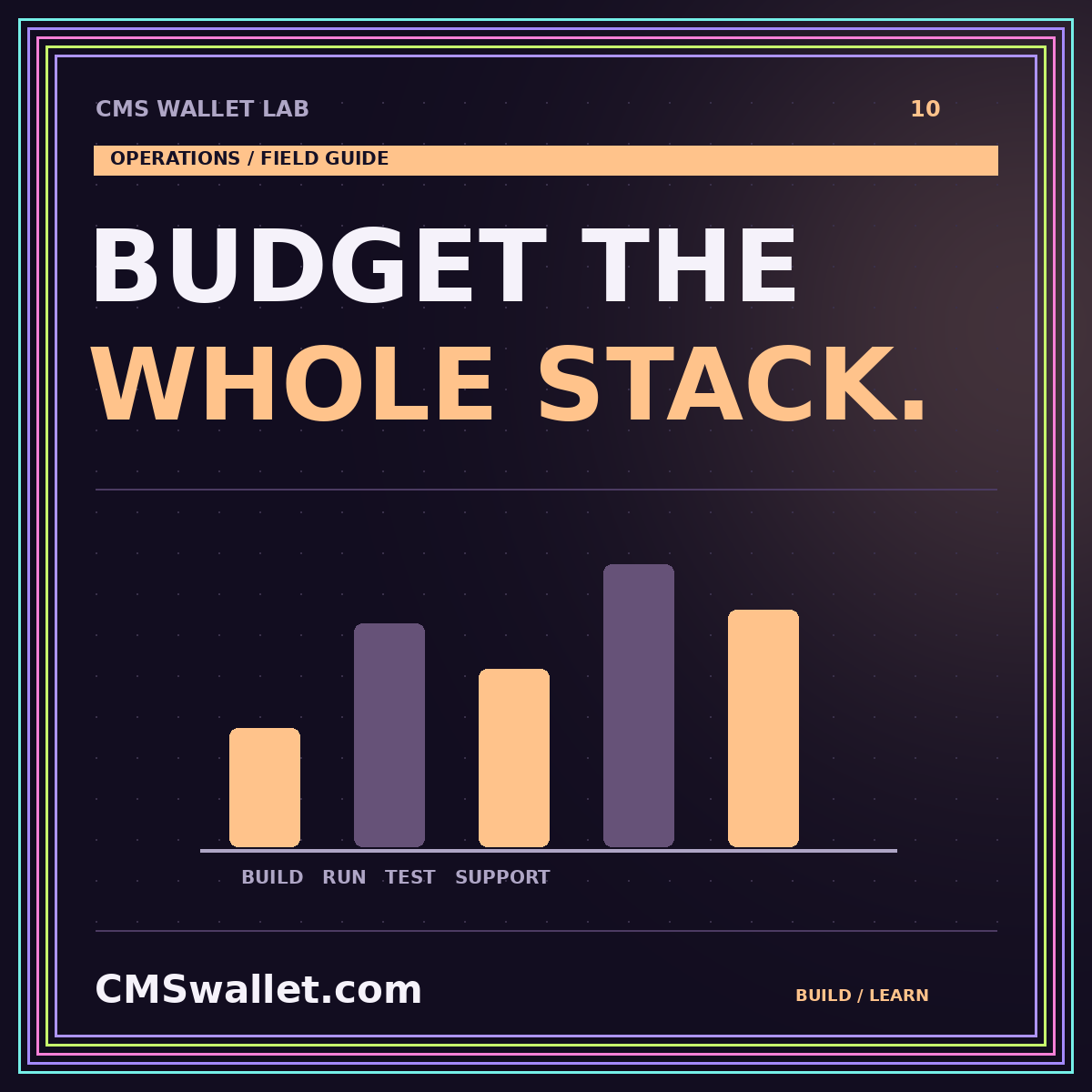
Use five headings in the planning sheet: build effort, fixed services, variable requests, network activity, and ongoing operations. Build effort includes design, integration, review, and release testing. Fixed services include plans the team pays for regardless of traffic. Variable requests cover metered infrastructure. Network activity covers the implemented transaction flows. Operations covers monitoring, support, maintenance, and incident recovery.
Assign an owner to each assumption. The person choosing the wallet interface may not know the media-delivery bill, and the editor may not know the payment observer's request limits. Naming owners helps expose missing information early. Do not put “free” in a cell simply because no one has yet identified which team pays for that component.
Distinguish network fees from service charges
The Ethereum documentation on gas and fees explains that gas measures computational work and that transaction fees depend on the network's fee mechanism and the work performed. That is different from a wallet-service subscription, an RPC-provider plan, or the publication's product price. Combining those charges into one number makes comparison difficult.
For other payment routes, examine their actual fee and service structure rather than assuming that an Ethereum calculation applies. Keep estimates dated and identify the source used when constructing a real budget. Avoid a headline such as “always cheaper” when the comparison depends on transaction type, usage pattern, provider terms, or a network condition that may change.
Model requests from reader behavior
Create a simple request inventory for each task. For example, a proposed membership journey might require a challenge request, a verification request, and an entitlement check. This is an illustrative architecture, not a universal minimum. Add the reads needed by the actual interface, then account for how often the application refreshes them.
Compare a design that polls continuously with one that refreshes at defined transitions. Measure whether the extra freshness improves the reader's task before paying for it everywhere. A public article page should not need to repeatedly inspect a wallet that the visitor has not chosen to connect. The CMS wallet architecture guide helps separate public reading from optional wallet-dependent services.
Include unsuccessful attempts
A failed or canceled journey can still consume requests and support time. Track the steps reached before failure rather than assuming that only completed purchases generate cost. A timeout followed by several retries may be more expensive to serve than a straightforward success, especially when the interface restarts work that could have been reconciled instead.
Build scenarios rather than one precise forecast
Use a baseline, a higher-traffic case, and a disruption case. Vary the assumptions that matter: task volume, retry frequency, average resource size, observer activity, and support demand. State that these are planning scenarios, not predicted outcomes. The purpose is to see which dependencies dominate the design under different conditions.
Keep the arithmetic transparent. Variable request cost can be modeled as task count multiplied by average billable requests per task and the applicable unit charge. Use actual provider definitions for billing units when the estimate becomes operational. Avoid false precision: an exact-looking total built from unmeasured behavior is still an uncertain estimate.
Account for the multichain test matrix
Adding another network may require more than another icon. Identify the additional account types, asset formats, transaction states, observer behavior, and support explanations the implementation introduces. Then list the environments actually supported. Each advertised combination should have a meaningful test path and an owner when it fails.
Keep the scope tied to reader demand. A publication can start with one carefully supported workflow and add another when there is a concrete reason. The Solana transaction guide and Bitcoin payment workflow show why superficially similar checkout screens can require different recovery logic behind them.
Budget for content and support operations
Readers need documentation for connection, cancellation, account changes, eligibility, payment status, and recovery. Someone must maintain that material as the implementation evolves. Include the work of reviewing support messages, correcting confusing interface copy, and updating compatibility information. These tasks affect whether the feature is usable even when the underlying code is technically functioning.
Define the support evidence the system will provide. A clear order reference and state history can reduce investigation time compared with a screenshot of a spinning button. However, collecting excessive sensitive data creates its own review and access burden. Design the minimum useful record rather than treating unlimited logging as a free substitute for understandable application states.
Compare hosted and self-managed responsibilities
A hosted service may take responsibility for specific infrastructure tasks, while a self-managed component leaves more operational work with the publication. Compare the actual responsibility split rather than assuming one model is always cheaper or safer. Review service limits, data handling, recovery tools, and the process for exporting the records needed to migrate.
For self-managed components, include backups, updates, monitoring, on-call access, and rehearsal of recovery procedures. For hosted components, include integration work and the consequences of an outage or account restriction. The WordPress plugin evaluation guide applies this approach to plugins that depend on services outside the WordPress installation.
Plan for spikes and partial outages
Decide which operations can be slowed, queued, cached, or paused during a disruption. Keep public reading available where the architecture permits it. For payments, distinguish disabling new invoices from reconciling existing ones. Stopping every worker indiscriminately may leave readers without a status for payments already in flight.
Assign a budget or resource limit to nonessential background work. Review alert thresholds against actual service limits and the time needed to respond. Avoid a plan that depends on someone noticing a surprise bill after the fact. The disruption scenario should identify both the technical switch and the person authorized to use it.
Replace assumptions with measured evidence
During a controlled pilot, record successful task completion, unsuccessful attempts, request counts, fulfillment delays, and support effort. Keep the measurement scope clear and avoid exposing private reader details. Compare observed behavior with the planning scenarios, then revise the estimate where the implementation differs from the original diagram.
Do not extrapolate from one flawless demonstration to the entire audience. Mobile app switching, slower connections, and unusual account configurations can change the operational workload. Document the limits of the pilot and expand gradually. A useful budget is a living record of assumptions and evidence, not a fixed marketing claim about the permanent price of web3 integration.
Conclusion: estimate the complete service
The cost of a multichain CMS wallet feature includes development, infrastructure, network activity, testing, content maintenance, and recovery. Begin with a defined reader task, keep fee categories separate, and make scenarios explicit.
Use the cryptocurrency CMS wallet overview to identify the relevant workflows before estimating them. The best planning outcome is not the smallest-looking number. It is a design whose responsibilities, limits, and operational costs are clear enough for the publication to sustain.