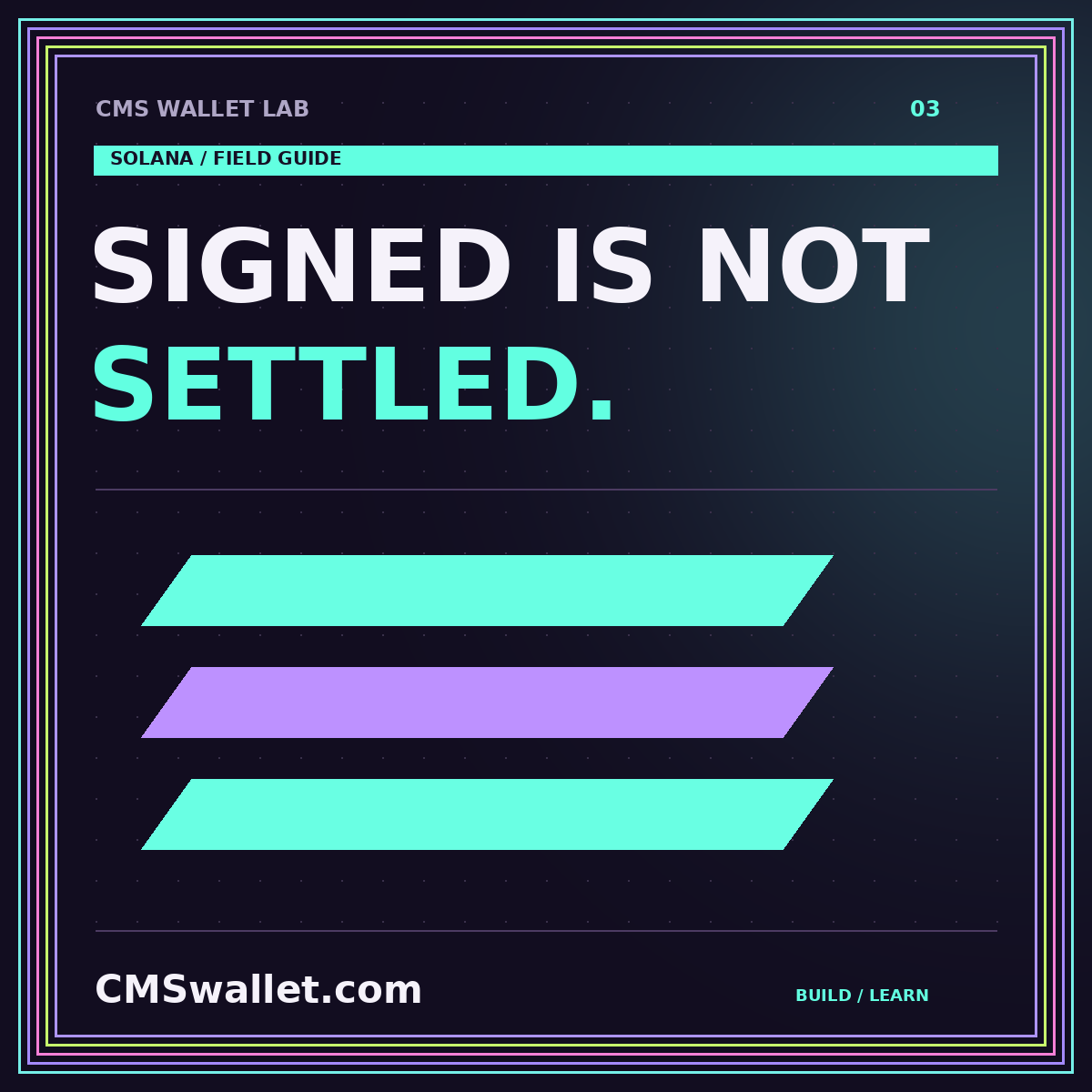
A Solana CMS wallet integration can look complete long before it is operationally clear. A wallet opens, a reader signs, and the page displays a green checkmark. Yet that checkmark may describe only a local action, not an accepted transaction or a fulfilled content purchase. Good transaction design makes the difference visible.
This guide develops an example in which a reader pays to access a digital workshop. It is a product and implementation planning guide, not a live checkout. The proposed workflow separates transaction preparation, wallet consent, submission, network observation, and fulfillment. That separation helps a publisher respond sensibly when the reader closes a tab, changes accounts, or encounters a delayed response.
Describe the purchase before describing the chain
Start with the resource being purchased, the accepted asset, the intended network, and the entitlement that successful payment creates. Is access permanent, time-limited, or attached to a particular account? Who can resolve a mistaken payment? These are publication policies, and the wallet cannot invent them for the team.
Show the purchase summary before requesting consent. The reader should see the workshop name and the payment destination context, not just an opaque operation. Keep quoted payment terms stable for the intended review window. When the terms change, explain the change and ask for a fresh review rather than silently replacing the transaction under the same confirmation screen.
Understand the transaction boundary
The Solana transaction documentation describes transactions as containing instructions, authorizing signatures, and a recent blockhash. Instructions within a transaction are processed together; when an instruction fails, its instruction state changes are reverted, although transaction fees are still charged. These mechanics support an important interface distinction: preparing or signing a transaction is not the same as establishing its successful execution.
Build the checkout around observable states rather than a generic loading spinner. The detailed instruction set should remain reviewable by the implementation team, while the reader sees a clear summary of the requested action. Avoid attaching unrelated operations to a content purchase simply because the wallet can present them together. Keep the initial payment workflow deliberately narrow.
Define a state machine with useful names
A proposed checkout might use prepared, awaiting approval, signed, submitted, observed, accepted, and fulfilled. Include canceled, failed, expired, and unresolved outcomes. The names are application choices rather than protocol states, but each should have a documented entry condition. Support should be able to explain what evidence moved an order into its current state.
“Submitted” should mean the application has submitted the relevant signed transaction, not that access has already been granted. “Fulfilled” should mean the publication has created the promised entitlement. Keeping these distinct allows a transaction observer and a content-delivery service to recover independently when one component is temporarily unavailable. The Solana CMS wallet overview connects this lifecycle to the rest of the CMS architecture.
Make unresolved an honest outcome
A timeout does not by itself prove either payment success or payment failure. Use an unresolved state when the application lacks enough evidence. Preserve the order reference and transaction identifier where available. Tell the reader that the status needs checking before starting another payment. This is more useful than replacing every uncertainty with “Try again” and potentially encouraging duplicate purchases.
Prepare for slow wallet approval
Readers may spend time reviewing a request, switch apps, or become distracted. For transaction types with a limited validity window, the application needs a defined way to detect that the prepared request is no longer suitable. Do not hide this condition behind an infinite spinner. Explain that a new request must be reviewed when the old attempt cannot proceed.
Rebuilding a transaction should not silently preserve an old assumption about price, network, or selected account. Revalidate the order context, prepare the new request, and obtain the necessary consent. Keep a link between attempts and the same underlying order so support can distinguish a replacement attempt from a second purchase. This is an application-level recovery design worth testing explicitly.
Track orders independently of browser tabs
Use a stable order identifier generated by the trusted purchase service. Associate each observed payment attempt with that order, but do not make the browser's memory the authoritative order record. A reader should be able to return to a recovery route after closing the page and see the relevant state through an authenticated or otherwise appropriately protected process.
Avoid placing sensitive recovery credentials in ordinary analytics events or shareable page titles. Decide which order details may be visible without a session and which require verification. A public transaction identifier does not mean every associated customer record should be public. The publication's support needs should guide a minimal data contract rather than an unrestricted transaction dump.
Verify the intended payment, not just activity
Define the evidence required for acceptance: the expected network, the intended recipient, the relevant asset, the required amount, and the application's chosen confirmation policy. The exact checks depend on the transaction format and payment service. Have the team review them against the actual implementation instead of relying on a wallet popup as the acceptance authority.
Keep the observer's result separate from a browser-supplied success message. A reader who edits local JavaScript should not be able to mark an order paid. Similarly, unrelated activity by the same address should not satisfy an invoice. The cryptocurrency CMS wallet guide explains how asset identity and reconciliation fit into a multichain publication.
Make fulfillment repeatable without duplication
Design the entitlement operation to be idempotent: processing the same accepted order again should not issue conflicting access records or multiple credits. Use a unique order-to-entitlement relationship and preserve the transition history. This helps when a worker retries after a timeout or an event arrives more than once.
Consider an outage immediately after the payment is accepted but before content access is created. The recovery process should inspect the order and finish the missing fulfillment step, not ask the reader to pay again. Test that sequence with deliberately interrupted components. It is a more meaningful readiness check than completing the happy path repeatedly on a fast development connection.
Separate network costs from publication pricing
Explain which part of the displayed amount belongs to the publication and which additional costs may arise from the transaction environment. Avoid hard-coded promises about future fees or completion times. For a production checkout, obtain relevant estimates from the implemented service at the time of the proposed action and state their limitations clearly.
Decide who handles an insufficient payment balance, an unsupported asset, or a network mismatch. These should be separate situations with separate explanations. Do not tell a reader to purchase more cryptocurrency as a generic troubleshooting step. First establish which condition actually failed, and provide a route to cancel or use another supported payment method where the product offers one.
Test recovery as carefully as payment
Build scenarios around slow approval, rejection, account changes, stale requests, submission timeouts, duplicate events, service restarts, and fulfillment outages. Test returning to the order from another tab after the first tab disappears. Verify that the order status remains understandable and that repeated checks do not create new payment requests.
Run mobile tests through the entire app-switching journey. A wallet may return the reader to a different browsing context than expected, so the checkout should not depend on a fragile sequence of screen animations. Record the environments that actually work. Use the integration cost planning guide to include this testing and support work in the project estimate.
Conclusion: make the evidence visible
A reliable Solana CMS wallet experience explains what has happened and what remains uncertain. Keep preparation, approval, submission, acceptance, and fulfillment distinct. Tie retries to a stable order, verify the intended payment through a trusted component, and make entitlement creation safe to repeat.
The resulting interface may be simpler than a dashboard full of live-looking indicators. That is a benefit. A reader trying to access a workshop needs a truthful status, a useful recovery path, and confidence that an interrupted page will not turn into an unnecessary second payment.