The phrase “AI tokens CMS wallet” can refer to two very different things. A blockchain token may be used in a membership or payment rule. A model token is a unit used when processing text through an AI system. Giving both the same label in a dashboard can create confusion about what a reader owns, what they can spend, and what the publication promises to deliver.
This guide proposes a design for a publication that offers an AI-assisted research feature to eligible readers. It separates blockchain eligibility, service credits, and measured model usage. The objective is an understandable access system, not a claim that holding a cryptocurrency automatically pays for computing resources or provides a guaranteed amount of future AI service.
Name the units before designing the interface
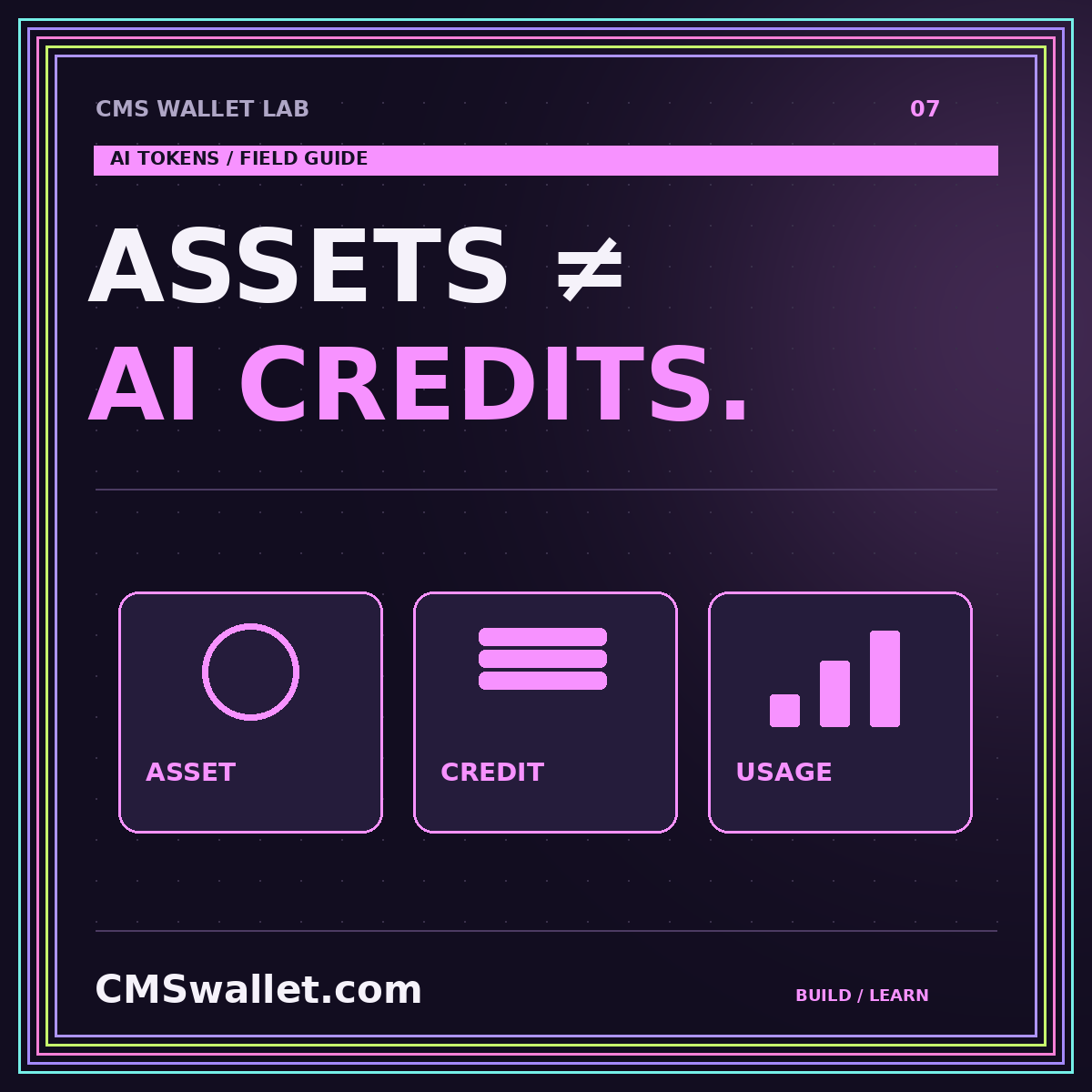
Write a small glossary for the product team. Use “asset units” for the blockchain balance, “service credits” for any internal allowance, and “model usage” for the provider-measured consumption relevant to the feature. Choose reader-facing names that remain distinct even when space is limited. A generic “tokens remaining” counter should not stand for all three.
For the example research feature, a reviewed asset rule might establish eligibility to start a session, while an internal allowance limits the work performed during that session. Whether the allowance refreshes, expires, or carries over is a product policy. Document that policy independently of the asset's market price or branding so the service promise does not depend on an unstated assumption.
Understand what a token interface does not define
The ERC-20 token standard specifies an interface for fungible-token balances, transfers, and allowances. Metadata such as name, symbol, and decimals is optional in that standard. It does not define AI inference credits, a model provider's billing rules, or entitlement to a CMS feature. Those relationships must be established by the application and its published terms.
Avoid identifying an accepted asset by its ticker alone. In a production policy, specify the network and exact contract or other appropriate asset identifier. Verify display-unit handling in the implementation. The broader AI tokens CMS wallet guide explains how an asset can participate in an access design without being mistaken for an AI service meter.
Define eligibility without implying investment value
Write the access rule around the service rather than a price narrative. For example, the proposed publication could require a verified account to satisfy a reviewed membership policy before using its research assistant. This is an eligibility decision. It does not establish that an asset is a good investment, will appreciate, or will retain the same access terms indefinitely.
Explain policy changes clearly before they affect readers. Decide how existing sessions and unused service allowances are treated when an accepted asset or membership condition changes. Avoid leaving a permanent promise embedded in an old image while the live policy says something different. Keep the visible rule and the operational policy version connected through the content model.
Keep eligibility and usage accounting separate
The eligibility service should return the access decision and the context needed to understand its scope. The usage service should track work requested, work reserved, work completed, and any adjustment needed after an interrupted response. Combining these into one balance makes it difficult to distinguish an ineligible reader from a reader who has used their allowance.
For the proposed research assistant, create a request identifier before starting provider work. Associate the usage record with that identifier and the authorized account context. Do not infer billing completion from a browser animation ending. If the page closes or the response stream is interrupted, the trusted service needs a way to reconcile what work actually occurred under its chosen accounting policy.
Reserve capacity before starting expensive work
Define a bounded request policy. Limit the allowed input, requested output, tools, and repeated attempts according to the actual feature. Before starting work, reserve an appropriate amount of the reader's internal allowance or reject the request with a clear explanation. The reservation design should account for concurrent requests rather than assuming a reader has only one tab open.
When the request finishes, reconcile the reservation against the usage evidence available from the implemented service. Release unused allowance according to the published policy. When the outcome is uncertain, keep a distinct pending or review state instead of silently charging the maximum forever. These are application-design recommendations; the exact accounting rules depend on the provider and the service contract.
Decide what cancellation means
A reader pressing stop does not necessarily tell every remote component to stop at the same instant. Define what the application attempts to cancel, how it records the outcome, and which work remains billable under the service policy. Explain this before a high-cost action rather than after the reader disputes a counter that kept changing following cancellation.
Do not make token approvals a default login step
A reader seeking access to a research feature should understand whether the application is asking for identity proof, an eligibility check, or a spending authorization. Keep those actions distinct. Where the design only checks a balance or membership rule, do not introduce a transfer-approval flow merely to make the interface feel more “wallet native.”
When an implemented purchase actually requires a payment operation, review that as a separate checkout with its own amount, destination, and recovery process. The Ethereum sign-in guide explains the identity side of the boundary. The cryptocurrency CMS wallet page covers the asset-identification and payment responsibilities that should not be hidden inside sign-in.
Protect provider credentials and content
Route privileged AI-provider requests through an appropriate trusted service. Do not put a reusable provider secret in a public static page or downloadable JavaScript bundle. A reader's wallet connection does not make browser-delivered credentials private. Restrict service permissions to the tasks the product actually supports, and plan how credentials are rotated or revoked.
Also decide which publication material may be sent to the AI service. Private manuscripts, licensed documents, and reader-supplied text need deliberate handling. Give the content model a clear distinction between public source material and restricted material. Do not treat access to one article as authorization to forward the publication's entire private archive into another service.
Treat generated instructions as untrusted input
In an AI-assisted workflow, text from documents or model responses should not automatically become authority to spend funds, change membership rules, or modify account permissions. Keep the system's operational controls outside the generated prose. A suggested action should pass through the application's existing permission checks and, where appropriate, a separate human review.
For the example research assistant, constrain the feature to reading approved sources and producing a draft response. Do not grant it wallet-signing capability as an incidental convenience. Expanding into transaction execution would introduce a different threat model and require its own design and review. This separation lets the publication improve a useful research feature without silently creating an autonomous payment agent.
Make the allowance screen explainable
Show eligibility status, remaining service allowance, and recent usage as distinct concepts. Explain when the allowance refreshes and what counts against it. Where a displayed value is an estimate, label it as such. Avoid converting asset balances into future model usage using an implied exchange rate that the publication has not actually committed to honor.
Give support a minimal record of request identifiers, policy versions, and usage adjustments. Avoid collecting complete prompts or responses by default merely because they might be useful someday. Decide retention according to the actual support need and published handling policy. A clear accounting explanation is more useful than a large log whose contents no one can safely review.
Conclusion: separate ownership from consumption
A responsible AI-token CMS design distinguishes asset eligibility, internal service credits, and actual provider usage. It defines each conversion or entitlement explicitly instead of relying on the word “token” to connect unrelated systems.
Use the headless CMS content model to keep policies separate from editorial copy. Start with a constrained feature, a bounded allowance, and a recovery process for interrupted requests. Readers should be able to understand what they can access and what they have consumed without interpreting a blockchain balance as a promise of unlimited AI service.